
All Our Kin’s technical assistance (TA) team collaborates with organizations across the country engaged in innovative work to grow family child care (FCC) in their local communities. In this edition of our TA blog, we connect with Sebastian Betzer, Program Manager for Michigan’s Family Child Care Network Initiative , and Joan Blough, Vice President for Innovation and Evaluation at the Early Childhood Investment Corporation (ECIC) in Lansing, Michigan. The Michigan Department of Lifelong Education, Advancement, and Potential (MiLEAP) is leading a statewide effort to strengthen the state’s local child care systems. As part of that effort, ECIC’s Child Care Innovation Fund is partnering with MiLEAP to administer Michigan’s Family Child Care Network Initiative.
Read on to learn about how ECIC and AOK have partnered on providing sustainable FCC business supports and training to network staff across the state.
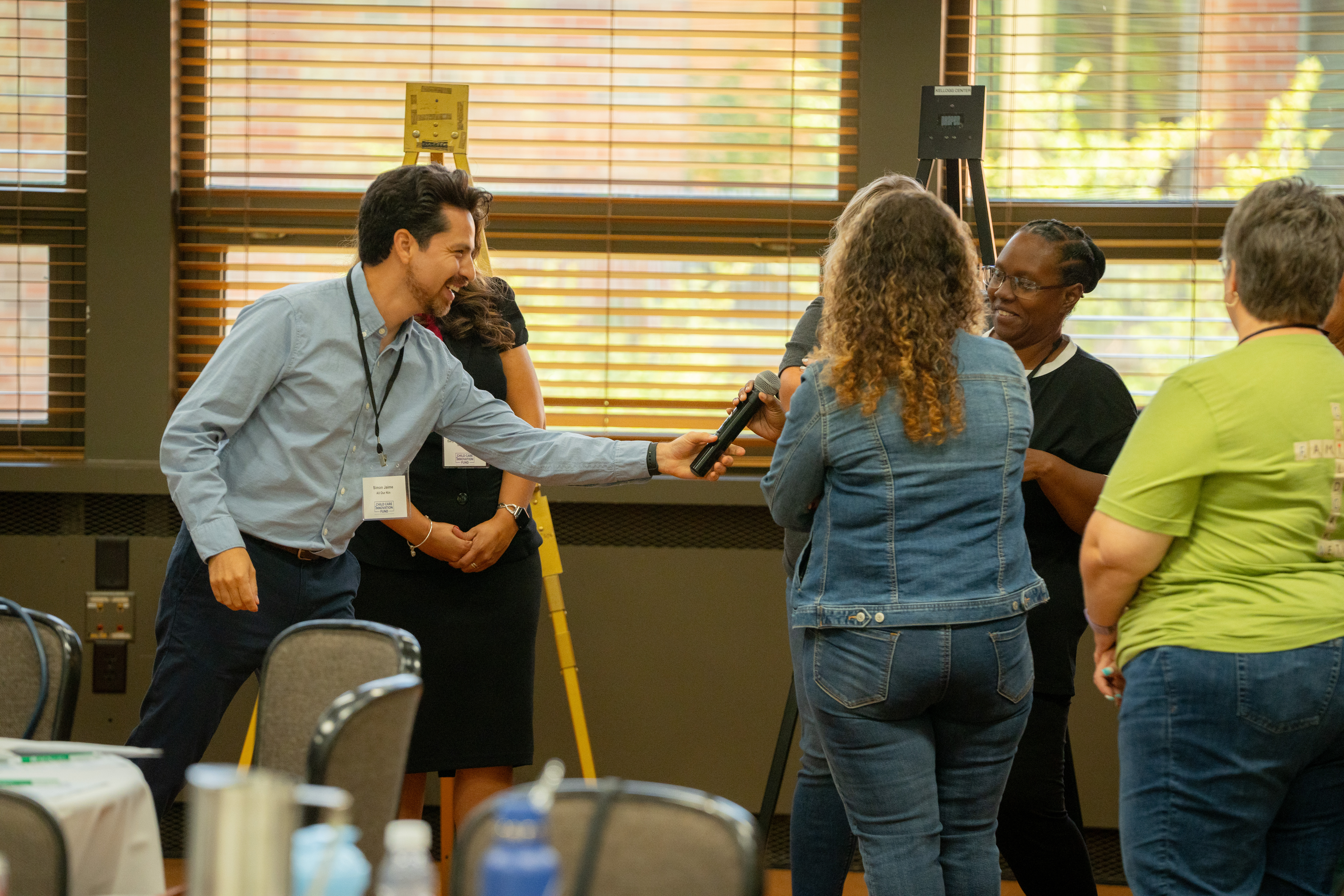
All Our Kin’s Simon Jaime with FCC educator LaShonda Cleveland at an ECIC training in Lansing, MI.
All Our Kin: Joan and Sebastian, could you please tell us about your roles and the work of ECIC overall?
Joan Blough: I’m the Vice President for Innovation and Evaluation at ECIC, which was founded in 2005 to be Michigan’s partner in early childhood system-building. Essentially, we function in a public-private space, and over the years we’ve helped the state to design, pilot, scale, and evaluate key elements of Michigan’s early childhood system infrastructure.
Sebastian Betzer: I'm the Program Manager for the Family Child Care Network Initiative, which is one of the initiatives under the Child Care Innovation Fund at ECIC. Our FCC networks model started as a pilot built from the evidence-based benchmarks developed by Home Grown and the Erikson Institute. In that early pilot, there were several organizations here in Michigan that were funded (through the Child Care Innovation Fund and MiLEAP) to create or strengthen their work operating FCC networks with home-based educators. That work has since continuously grown into a best practice approach that stays responsive to those educators' needs. Increasingly, the focus is on the business sustainability of home-based educators, which in turn sustains more choices for children and families to find care that meets their needs and preferences.
AOK: You’ve touched on the goals of the Family Child Care Networks Initiative. What is the scope overall? How many networks are there and how many educators are you reaching through those services?
SB: We work with 13 hub organizations throughout the state, each of which operates between one to four networks. Those networks serve up to 25 network members. Out of the 13 hub organizations, we currently have 30 networks serving 643 FCC educator members across Michigan. That number has been consistently growing every quarter, which is really exciting. We’re actively serving 54 of Michigan’s 83 counties.
AOK: That’s impressive! Can you talk about the services the networks provide beyond business coaching and training?
SB: The scope of the FCC networks is broad because the benchmarks for a high quality network experience are broad, covering business strength and economic sustainability, programmatic quality, and connecting children and families in home-based care to comprehensive services through referral and follow-up. Educator voice also drives each network's focus, which creates variation that is tailored to the specific needs of each community as they are raised in network meetings.
JB: We had legislation that really kicked all this off in Michigan, which was written before the benchmarks were published. Once the benchmarks were available, we were able to cross-walk them with the legislation and proposed them as the framework for implementation to MiLEAP. So the benchmarks have really been the cornerstone of this whole initiative from the beginning. MiLEAP strongly values home-based child care as a key component of the mixed delivery system for early care and education. Their support has been essential to the success of this initiative.
AOK: It sounds like Michigan has created the conditions for home-based child care to thrive! Could you share more about how educator voice helps to guide the direction of each network?
SB: Including the perspective of the educators we serve is foundational to ECIC as a whole. Within the FCC networks initiative specifically, the role of FCC educators is pivotal, and it shows up in both formal and indirect ways. Formally, the networks use educator voice directly to shape the services and trainings they offer and to define what high quality and meaningful outcomes look like for their communities. Indirectly, the data we collect also serves as an indicator of educator voice, informing how we adjust the initiative, decide on technical assistance, and frame our successes, because we're ultimately responding to how home-based business owners tell us things are working.
JB: Since its founding, ECIC has had a focus on system design as co-led through lived experience. There’s an unfortunate mindset in the field at times which doesn’t view home-based educators as entrepreneurs and business owners. One of the most powerful things we do at ECIC is invite our partners from state-level organizations to benefit from the presentations provided by home-based educators during our annual in-person meeting. The partners leave those meetings changed, because they hadn’t really experienced how powerful, intentional, and entrepreneurial these FCC educators are.
AOK: How does the FCC Network Initiative contribute to the vision for your team, and what are you hoping to achieve for educators, children, and families in Michigan?
JB: Ideally, we want there to be actual parental choice regarding the setting that most meets a family’s needs and preferences for child care. That is a cornerstone of the federal Child Care and Development Block Grant, and it's also a cornerstone of ECIC's work. We know that home-based child care fits the needs of many families in Michigan, because we have a lot of jobs that don't happen 9 to 5, and some families just don't prefer center-based child care. So if we want to help lead the growth of child care supply that is needed to meet the unmet need we currently have, then home-based child care is an essential component of that.
SB: On a day-to-day level, there's this broad vision that you need to have a strong and sustainable home-based child care business in order to build on top of it all of the other things that are so important. Program quality and the supports for children and families – all of that is sustained when there is an underlying economic support base. Once the core things are in place to ensure educators are still going to be in business, you see a big change in how much people are able to take on, whether that's the quality level they want to achieve or taking on leadership and talking to decision makers in their county or municipality. That all starts to happen when people can feel more secure that their business is strong and that they can profit from it.
AOK: Can you share about how ECIC originally connected with All Our Kin?
JB: This work has been a long time coming in Michigan. I've known about All Our Kin's work for a while. I deeply respect the way that AOK has been able to evaluate the Business Series because we want to invest in strategies that we know are really going to impact root causes. The evidence around the Business Series and educators’ profitability in particular, in addition to the importance of both peer-to-peer support and expertise from a coach, someone to help you think deeply about your business and your practices – those are things we've always been thinking about.
SB: For this specific collaboration, it emerged from feedback from our FCCN hub staff. They had done a lot of business trainings and connected educators with tax specialists, and they were starting to feel tapped out on their ability to support. So ECIC was looking for additional capacity-building resources to help FCCN hub staff feel ready to tackle more in-depth questions about something that's really core to this initiative. We put out a competitive request for bids and invited several organizations to apply. One reason we invited All Our Kin was that two of our hub organizations had independently sought AOK out, gone through the Business Series Train-the-Trainer (TTT), and already started offering Business Series courses to FCC educators. Your application was incredibly strong, and it was clear it would both increase the capacity of the hub staff and provide a sustained benefit for the network members.
AOK: That’s great to hear. What are the nuts and bolts of the business supports that we’ve been collaborating together on?
SB: The TTT collaboration was to make sure we could have certified trainers at every single one of the hubs, and we succeeded in that. We had 20 hub staff go through the TTT certification, which was awesome, and some hubs now have more than one. In the next 12 months, all 13 hub organizations will be offering at least one Business Series iteration, which means over 190 home-based child care business owners across the state will be able to take advantage of this. Critically, it lays that vital foundation for home-based business owners and sets them up well to take advantage of other small business tools and resources that are already available and will be continually tailored to ECE. We're helping people to see themselves as business owners, oftentimes for the first time. They can learn about topics that initially feel overwhelming such as marketing, and maximizing tax deductions using the time-space percentage calculation. The immediate feedback we hear is, “I learned things that I didn't realize were part of running my business successfully."
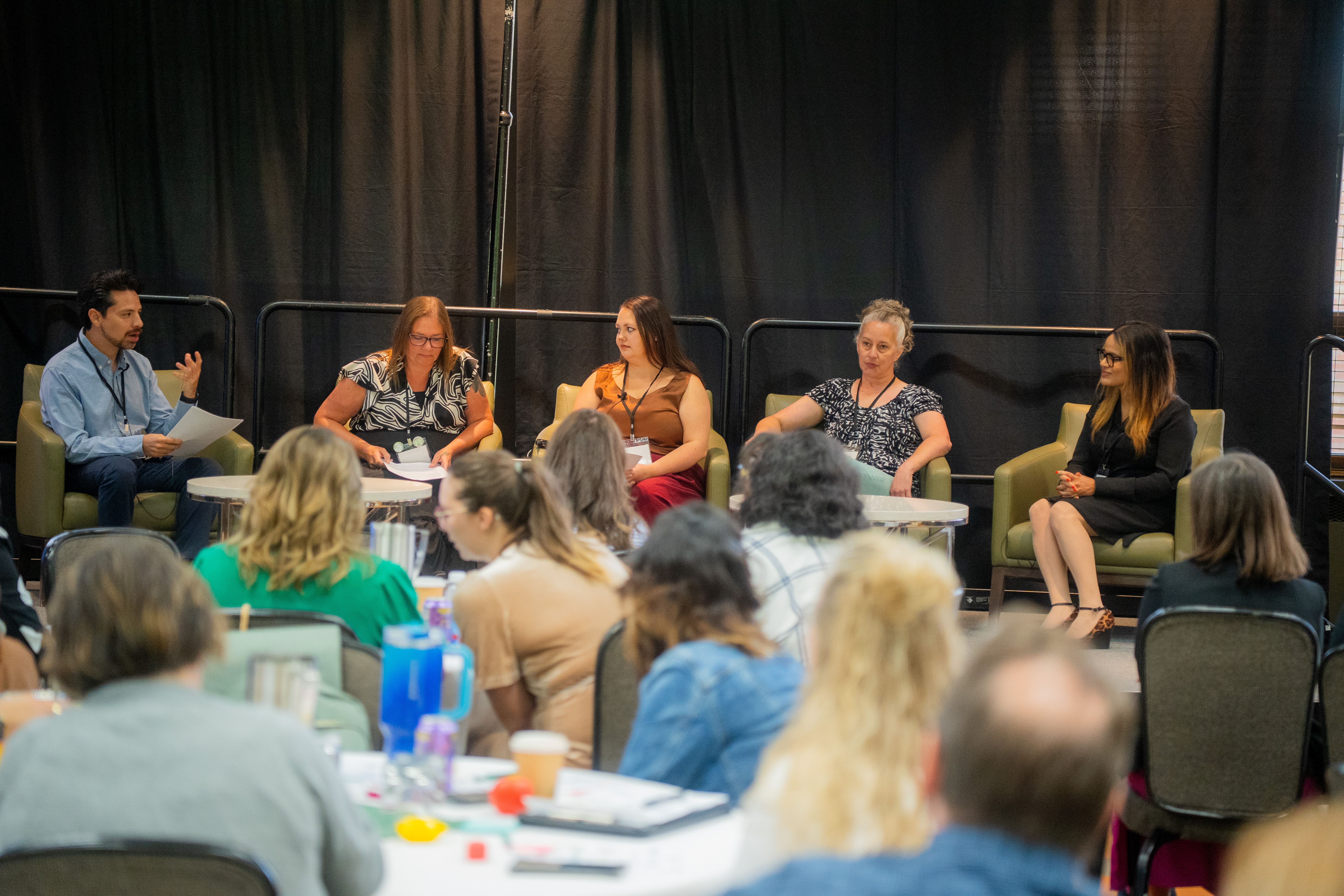
A panel of AOK Business Series graduates and trainers (from left to right: Simon Jaime, Rebecca Keller, Felicia Gill, Kelly Chambers, and Awilda Diaz)
AOK: What difference do you think it makes to partner with All Our Kin on business training?
SB: The partnership with All Our Kin, first and foremost, brings extensive experience. Being able to hear from other certified trainers around the country has helped our facilitators feel much more confident, because they've heard from people who had their own first time once and learned a lot along the way. That continued connection to leading with educator voice is essential to this partnership, and it wasn't 'here's your curriculum, there you go.' There's always been encouragement to identify what works in your community, try that, learn from it, and then share what you've learned with other trainers, and the technical assistance has always met the needs of our facilitators where they're at. We saw a substantial increase in the business knowledge our hub staff showed after the TTT week, and it's valuable to them to know they can participate in the communities of learning All Our Kin hosts nationally and attend another TTT if they have staff turnover.
AOK: Do you have any anecdotes that you’d like to share about our partnership?
SB: The first would be the panel at our in-person event for hub staff in Lansing, back in July. There was a lot of preparation that went into that, and we deeply value the level of respect that All Our Kin’s Simon Jaime brought to the panelists to enable them to tell their specific story in their own words. It was incredibly moving to hear from Business Series graduates about how their prior knowledge and experience weren't sufficient to run their business in a stress-free way, and about building profit where they hadn't realized it before and adding to their household's family wealth.
The other was the TTT virtual series. It's not typical for the funder to participate, but we were able to join the Zoom room and learn alongside the trainers and the hub staff. I want to thank All Our Kin’s Joel Rivera for skillfully navigating that process and facilitating a space that was equal, where we were all learners, on the same team, building something really strong together. That made a huge difference.
We are grateful to Sebastian, Joan, and the team at ECIC for their thoughtful and dedicated collaboration! For more information on AOK’s technical assistance, you can sign up for our newsletter here.