A growing body of research points to family child care (FCC) networks (aka home-based child care networks) as a promising strategy for supporting FCC in local communities. There isn’t yet a lot of research on the long-term impacts of networks, but to understand the trajectory of a network over time, its secondary impacts, and to make a strong case for sustainable multi-year funding, networks must plan with long-term impacts in mind.
In All Our Kin’s network development technical assistance (TA), one of the first steps we often take with partner organizations is supporting them in completing a theory of change (TOC) model–essentially a road map for what the network seeks to accomplish, how they plan to do it, what it will take, and what success will look like. Our TOC model maps priorities, inputs, activities, participation, short-term and long-term outcomes, as well as assumptions and external factors.
Identifying and demonstrating long-term outcomes (the ultimate changes expected to occur as a result of network implementation) is usually the most challenging part of constructing a TOC. Long-term impact evaluations are costly, labor intensive, and dependent on strong, trusting relationships.
During a recent Home-Based Child Care Data & Research Roundtable meeting on developing a TOC hosted by the Center for Home-Based Child Care (HBCC) Research,* Jennifer Drake, Director of Network Development on All Our Kin’s TA Team, had the opportunity to get insight from two leading researchers in the field of FCCnetworks, Juliet Bromer, Ph.D., Research Professor, Director, Center for Home-Based Child Care Research, and Toni Porter, Principal Consultant at Early Care and Education Consulting. Read on for their conversation!
Jennifer: Toni and Juliet, thanks so much for this rich discussion on developing a theory of change for HBCC research and evaluation. I’d like to raise a question that comes up a lot for network planning teams concerned about being able to measure long-term outcomes. What are your thoughts on being able to measure long-term family and child outcomes versus more proximal, short-term provider-focused outcomes?
Juliet: Good question. Networks can think about long-term outcomes, but don’t forget to elevate the importance of provider experiences as they relate to child and family outcomes. The impact that provider experiences have on children’s day-to-day experiences–the right now–is important and we’ve gotten away from that. The well-being of the provider, and how confident and supported she feels about the quality of her program and the sustainability of her business, will likely contribute to children’s experiences in her program.
Toni: Yes, and networks can also think about shortish outcomes we can measure, e.g. improved child health could be measured by a reduction in reported incidents of illness or emergency room visits. For improved language, cognitive skills, or social emotional development, there are accessible instruments to measure those. While these kinds of instruments may not be perfect, they can provide useful data.
Juliet: Also, think about where we can use provider and family reports about child outcomes. For example, what observations do providers document about children’s learning and development? What are family perspectives on their children’s growth and learning in FCC?
Toni: Work back from the big, long-term outcome and narrow it to something you can measure.
Jennifer: These are great tips, Juliet and Toni. Are there additional resources you’d recommend for network teams interested in evaluation?
Juliet: Yes, check out Getting to Impact in Home-Based Child Care Networks: Evaluating Implementation, Outcomes, and Long-Term Effects (2025); Designing and Evaluating Publicly Funded Home-Based Child Care Networks (2025); and Building Comprehensive Home-Based Child Care Networks: Evaluation Toolkit | Erikson Institute (2021).
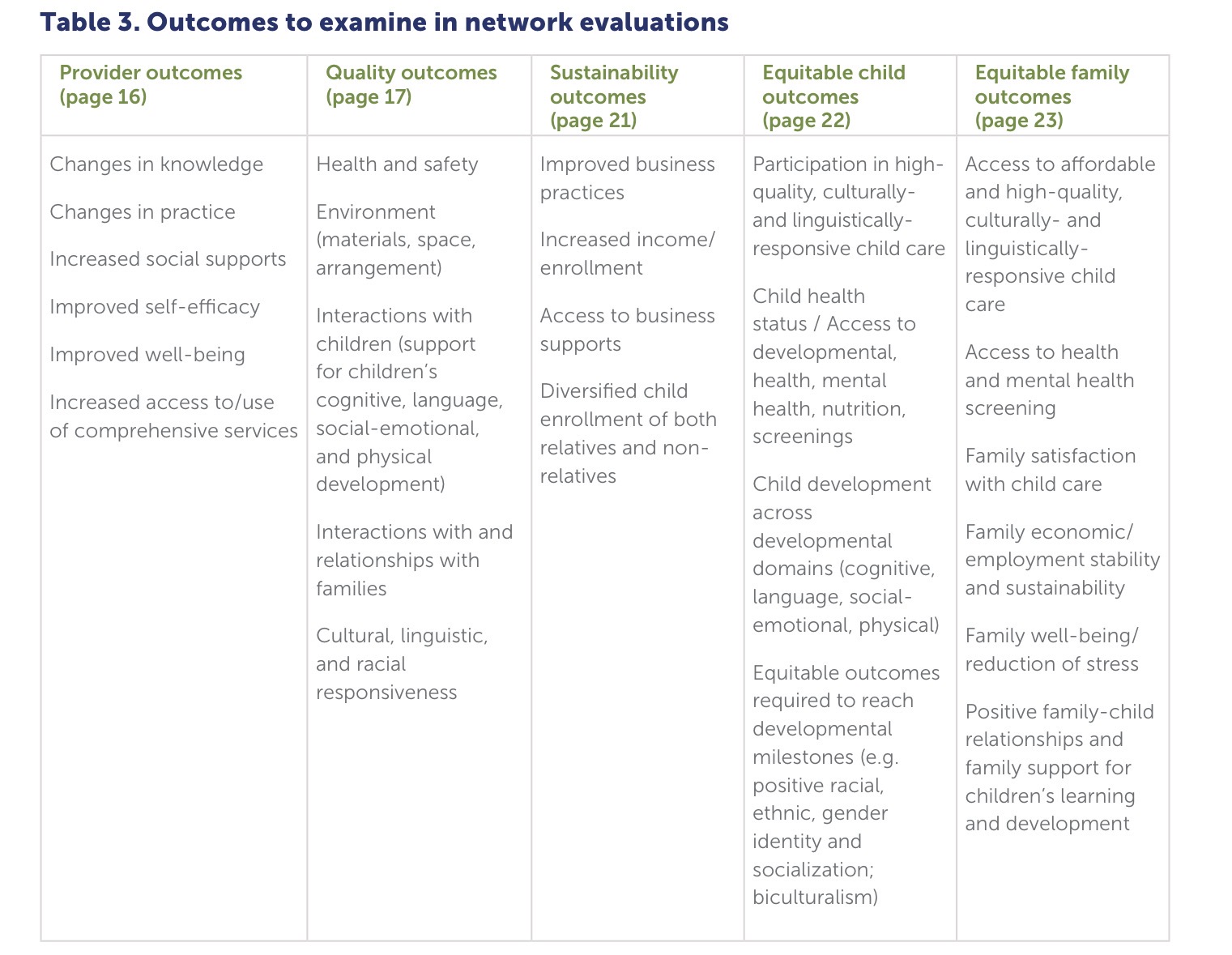
Toni: In the Evaluation Toolkit that Juliet mentioned, there’s a table (page 9) with examples of long-term outcomes that networks may want to consider examining for providers, program quality and sustainability, families, and children.
Jennifer: Thank you both, so much. I look forward to the next Data and Research Roundtable.
*The Center for HBCC Research supports research about HBCC in states, territories, and/ or local community contexts throughout the United States. It’s led by Erikson Institute in partnership with University of Delaware, Indigo Cultural Center, University of North Carolina at Chapel Hill, and the National Association for Family Child Care (NAFCC). All Our Kin’s co-founder and CEO, Jessica Sager is a member of the center’s Advisory Council.
How is your network assessing long-term outcomes? Contact the research team at the Center for HBCC Research at hbccresearch@gmail.com.
Interested in All Our Kin’s FCC Network Theory of Change template and help with completing it? Let us know at technicalassistance@allourkin.org.
We’d love to hear from you!